
5. The Stack
The Stack is a memory section of the SRAM that follows First-In-First-Out (FIFO) principles. It is generally used to store temporary data for quick and easy access.
The top of the stack is tracked by the 16 bit (adjusting to memory addressing) Stack Pointer that stores the address. It increments and decrements accordingly.
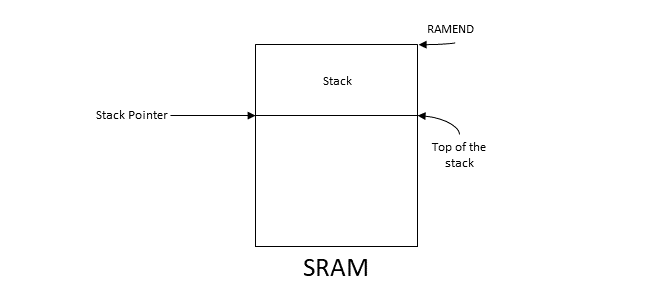
The stack grows downwards meaning that newer data is placed on lower memory address.
The top, is in fact, the bottom
The stack is used during subroutine (think of functions) calling to store the previous program counter when called with RCALL or ICALL. The program then restores the program counter to return to the previous location with RET.
Aside from subroutines, you can utilize the stack for your own use. The following are instructions that affects the stack.
| Instruction | Stack Pointer | Description |
|---|---|---|
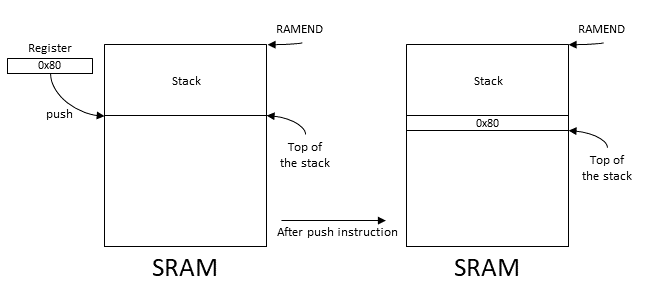
| PUSH Rd | SP = SP - 1 | Value in Rd is pushed onto the top of the stack. |
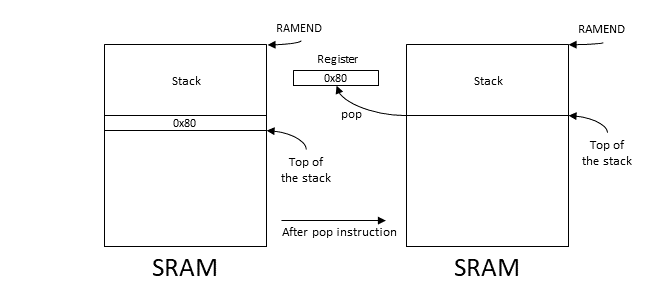
| POP Rr | SP = SP + 1 | The top of the stack is popped into Rr |
| RCALL ICALL | SP = SP - 2 | PC is stored onto the stack. Program jumps to the subroutine. |
| RET RETI | SP = SP + 2 | The top of the stack is popped back into PC. The program returns to the caller address. |
Push Operation
Pop Operation
Using Stacks
A very useful use case for stacks is as temporary storage without using up temporary registers to reduce mental overhead. For example, you might swap the contents of two registers R16 and R17.
PUSH R16        ; temporarily store R16
MOV  R16, R17   ; overwrite R16 with R17
POP  R17        ; return the temporary data to R17
This form of temporary container may become handy as your program grows. Even though AVR provides 32 general purpose registers, keeping track each and every single one of them may become harder as your program grows with more subroutines. One subroutine might unintentionally modify a register that you were using during its execution which might produce unexpected results.
For example, given a subroutine that interact with USART using R24
SER_send_byte:
  LDS   R24, UCSR0A     ; R24 is filled with the content of UCSR0A
  SBRS  R24, UDRE0
  ...
  RET
Calling it from main would unexpectedly modify R24
main:
  LDI   R24, 0b00001010
  ...
  RCALL SER_send_byte
  OUT   TCCR0B, R24      ; this behaviour might be unexpected since R24 is no longer the same
Aside from giving proper documentations to subroutines which provides information on affected registers, the stack can be used to store values in affected register and retrieve it before returning.
; Sends R16 to USART
; Blocks while UDRE0 is not ready.
; Registers Affected: R24
SER_send_byte:
  PUSH  R24             ; stores R24
  LDS   R24, UCSR0A
  SBRS  R24, UDRE0
  RJMP  SER_send_byte
  STS   UDR0, R16
  POP   R24             ; retrieve the value back to R24
  RET
Do keep in mind that this would add an overhead by using additional cycles and memory for storing into the stack.
No comments to display
No comments to display